
How AODD pumps work: principle, components and selection.
Compressed air drives two diaphragms through alternating suction and discharge strokes. Learn the cycle, then compare a pump for your actual fluid, flow and pressure.
Material selection
02Performance and cycle
03Troubleshooting and questions
Principles of AODD pump operation
Air-operated double-diaphragm (AODD) pumps are reciprocating, positive-displacement pumps. Each completed stroke displaces fluid from one of two liquid chambers. Compressed-air pressure and air volume together determine the available pumping duty.
The moving wetted components include two diaphragms joined by a common shaft, two inlet valve balls and two outlet valve balls. The diaphragms separate compressed air from the liquid. Air pressure drives the diaphragms, balancing their load, while the ball valves open and close against their seats to direct liquid flow. Adjusting the air supply allows the operator to match pressure and flow to the process.
When the air distribution system supplies the right air chamber behind its diaphragm, that diaphragm moves away from the center block toward the liquid chamber and pulls the opposite diaphragm inward. The opposite chamber is then on its suction stroke: atmospheric pressure pushes fluid through the inlet manifold, lifts the inlet ball from its seat and fills the liquid chamber.
At the end of the stroke, the air valve redirects compressed air behind the opposite diaphragm. That diaphragm moves outward while pulling the right diaphragm toward the center. The inlet ball on the discharging side closes; the outlet ball lifts from its seat and fluid exits through the discharge manifold. Alternating the air supply repeats the filling and discharge process on the two sides.
When the pump returns to its original starting position, each diaphragm has completed one suction stroke and one discharge stroke. This is one complete pumping cycle.
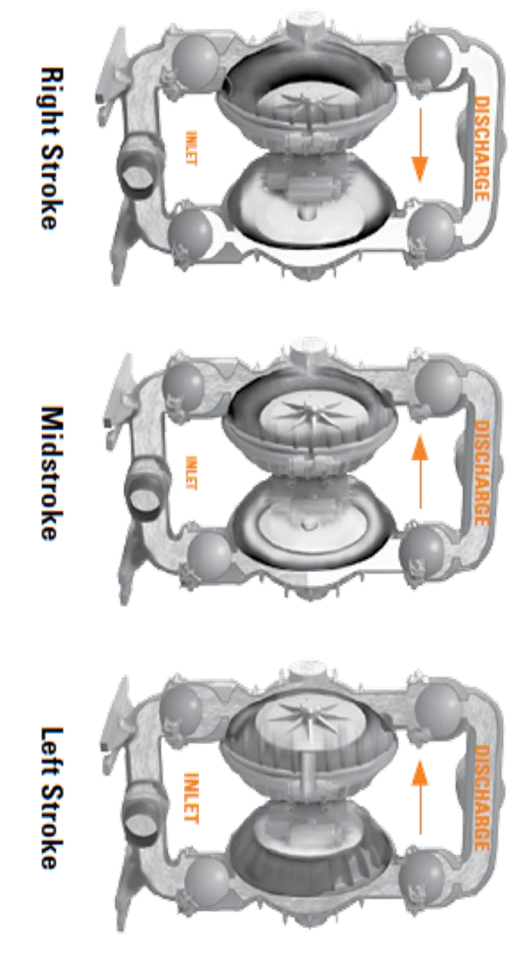
Suction and discharge in one continuous cycle
Compressed air alternates between the chambers behind diaphragms A and B.
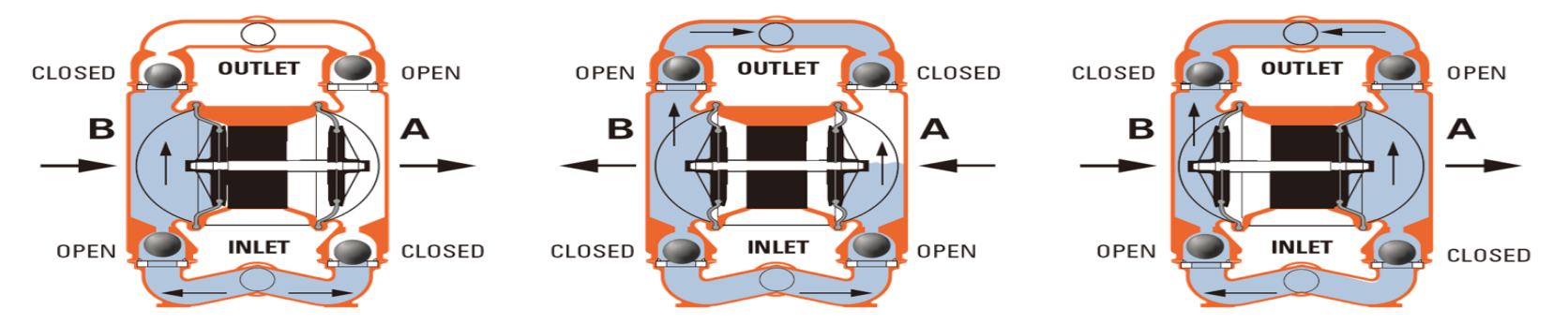
- The air valve directs pressurized air to the back of diaphragm A.
- Compressed air moves diaphragm A away from the center of the pump.
- The common shaft pulls diaphragm B inward as diaphragm A moves outward.
- Diaphragm B is on its suction stroke. Its movement creates a vacuum in chamber B; atmospheric pressure pushes fluid into the inlet manifold and lifts the inlet valve ball off its seat.
- At the end of diaphragm A’s discharge stroke, the air valve redirects compressed air to the back of diaphragm B.
- Air pressure moves diaphragm B away from the center while pulling diaphragm A inward.
AODD pump questions
What does AODD stand for?
AODD means air-operated double diaphragm. Compressed air alternately drives two linked diaphragms.
Can an AODD pump self-prime?
Many AODD pumps can self-prime, but actual lift depends on the model, fluid, line arrangement and whether the pump is wet or dry.
How do I select an AODD pump?
Use fluid composition, viscosity, solids, temperature, required flow at pressure, suction conditions and compatibility of every wetted component.
Discuss your operating conditions.
Email and WhatsApp include the current source page; you still review and send the message.