
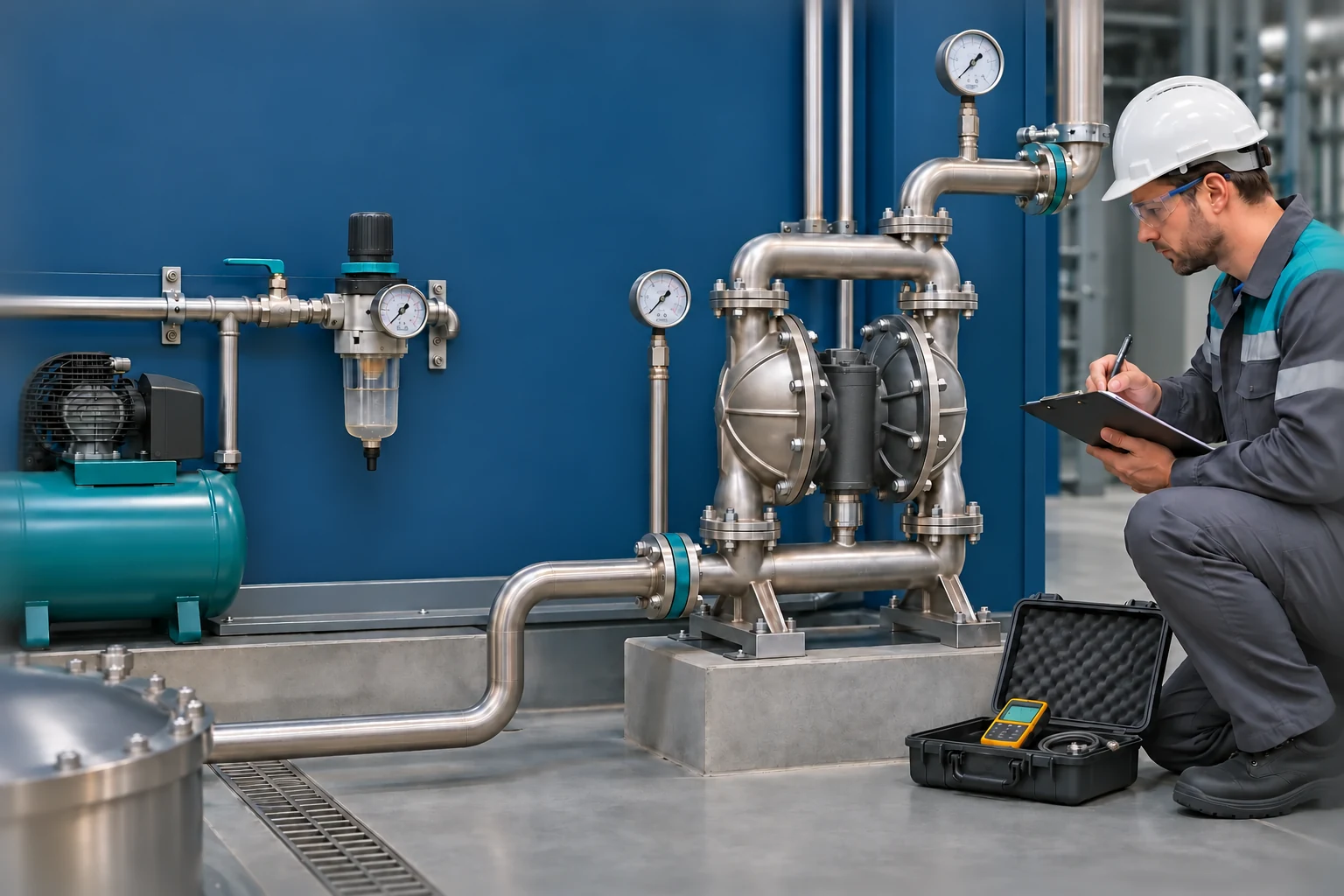
1. Start from the required liquid duty
Record the required flow and total discharge pressure, including static head and line losses. Select against the applicable performance curve rather than the catalogue maximum flow. A pump running near maximum cycling speed is rarely the best efficiency or service-life choice.
2. Measure pressure at the pump inlet
A compressor-room gauge does not show the pressure available while the pump is cycling. Measure at the point of use under load. Check the dryer, filter, regulator, quick couplings and hose for differential pressure before increasing the compressor setpoint.
3. Remove liquid-side restrictions
Undersized pipe, a blocked strainer, excessive fittings or a collapsed suction hose forces the pump to cycle harder for less delivered flow. Compare suction and discharge pressure with the design basis and correct the restriction before adding air pressure.
4. Treat leaks as a system fault
The U.S. Department of Energy notes that leaks can waste 20–30% of compressor output in poorly maintained systems. Tag, repair and verify leaks around couplings, hoses, regulators, drains and valves, then review compressor controls after demand falls.
5. Verify the result with repeatable data
Record flow, point-of-use pressure, cycle rate and air consumption before and after each change. Keep only changes that preserve the required duty and stable operation. Do not reduce air pressure below the level needed to overcome the actual discharge pressure.